


You may also like
-
Skate Board Brake Patent Poster
Albert O. Waddell · 1969 · Precise skateboard brake patent print with crisp diagrams on warm aged paper
Plakat od 40,50 zł · W ramce od 72 zł
Cena regularna Od 27,00 złCena regularna -
Turntable Patent Poster
Robert M. Like · 1977 · Technical turntable patent poster with labeled diagrams and clean black linework
Plakat od 40,50 zł · W ramce od 72 zł
Cena regularna Od 27,00 złCena regularna -
Film Reel Patent Poster
Michael G. Delaney · 1897 · Crisp film reel patent vintage print with precise diagrams and numbered components
Plakat od 40,50 zł · W ramce od 72 zł
Cena regularna Od 27,00 złCena regularna -
Flute Patent Poster
D. Julliot · 1874 · Detailed flute patent vintage print with crisp schematics and archival beige paper
Plakat od 40,50 zł · W ramce od 72 zł
Cena regularna Od 27,00 złCena regularna


-

'Bardzo ładne plakaty. Jakość jest świetna i dostaliśmy je naprawdę szybko!'
-

'Sklep, do którego naprawdę warto zajrzeć. Ogromny wybór plakatów. Spędziliśmy tam ponad godzinę!'
-

'Świetne miejsce na prezent. Ceny są naprawdę dobre, a na miejscu mogą też wszystko oprawić i zapakować.'
About the Artist
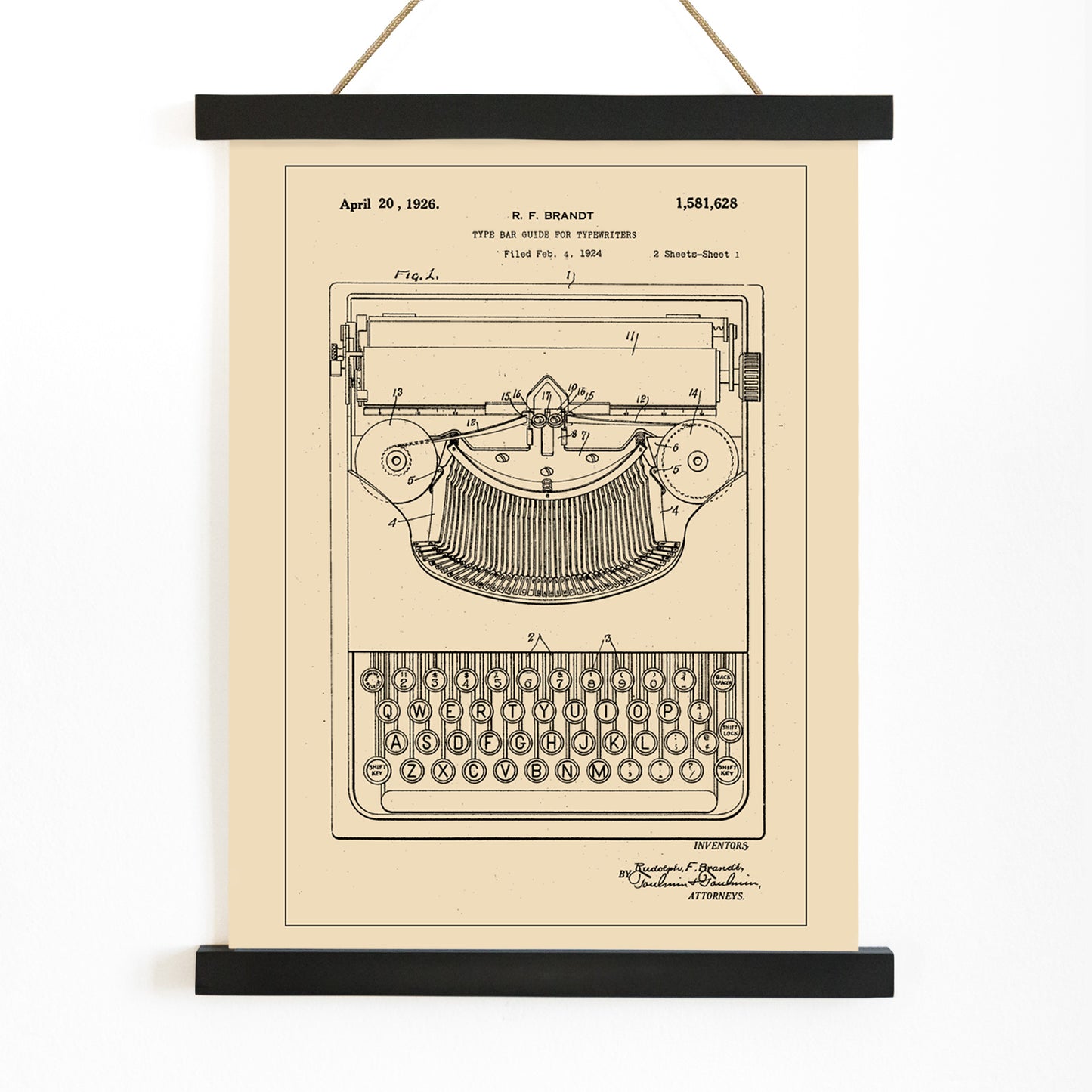
Robert F. Brandt is credited on this 1878 typewriter patent as the inventor behind a new approach to writing-machine engineering. Patent sheets like this one sit at the intersection of design and industry, where clear drawing mattered as much as the idea itself. In the nineteenth century, these diagrams followed strict US Patent Office conventions, turning innovation into a readable visual record.
Today, the document functions as both historical evidence and refined decorative art, ideal for collectors drawn to early technology and graphic clarity.
The Artwork
This typewriter patent print comes from a moment when modern office life was being invented in real time. As business correspondence expanded and bureaucracy grew, inventors competed to make writing faster, cleaner, and more reliable, and patents became the official language of progress. The sheet was created to define an invention precisely, so it could be protected, manufactured, and improved.
Beyond its legal purpose, it captures the broader story of communication shifting from handwriting toward machine-assisted text, a transformation that reshaped journalism, administration, and everyday work.
Style & Characteristics
The composition is organized like a technical atlas: multiple schematic views, numbered parts, and blocks of formal patent text arranged for quick comparison. Fine, steady black linework gives the mechanism a crisp presence, while the aged paper tone reads as warm beige, lending a quiet archival character. The overall look is balanced, rational, and satisfying to study up close.
As wall decor, it works as a vintage print that feels both minimalist and richly detailed, bridging engineering culture with classic graphic design.
In Interior Design
This typewriter patent poster suits a home office, library, studio, or hallway where you want an intelligent focal point for a gallery wall. Pair it with matte black frames, pale woods, and leather accents for an understated industrial mood, or let it soften a modern space with its beige paper warmth. It also complements typographic objects, notebooks, and analogue photography.
For coordinated browsing, explore science and engineering prints, black and white wall art, or beige toned art prints.