


You may also like
-
Violet Poster
Wassily Kandinsky · 1923 · Geometric abstract art print with violet, blue, and yellow shapes on pale ground
Plakat od 40,50 zł · W ramce od 72 zł
Cena regularna Od 27,00 złCena regularna -
Kleine Welten IV Poster
Wassily Kandinsky · 1922 · Abstract art print of circles and angular lines with bright blue yellow green accents
Plakat od 40,50 zł · W ramce od 72 zł
Cena regularna Od 27,00 złCena regularna -
Free Curve to the Point Poster
Wassily Kandinsky · 1925 · Monochrome abstract poster of curves and geometric forms with a poised focal point
Plakat od 40,50 zł · W ramce od 72 zł
Cena regularna Od 27,00 złCena regularna -
Kleine Welten II Poster
Wassily Kandinsky · 1922 · Rhythmic geometric art print with floating circles, sharp lines, and a bold black field
Plakat od 40,50 zł · W ramce od 72 zł
Cena regularna Od 27,00 złCena regularna


-

"Very nice Posters. The quality is amazing and we received it very quickly !"
-

"A shop to visit absolutely. Huge selection of posters. We spent more than an hour there !"
-

"Perfect to find gift. Price are very good. An they can frame and pack it on site"
About the Artist
Wassily Kandinsky was a pioneering figure of modern abstraction, whose exploration of color, form, and composition helped define the visual language of the early 20th century. His theories connected painting to music, emphasizing the emotional resonance of abstract elements over representational content.
By 1932, Kandinsky was living in Germany and teaching at the Bauhaus, where he further developed his ideas about geometric abstraction. This period marked a synthesis of his earlier expressive style with a more analytical approach, making his work a touchstone for those interested in the evolution of abstract art. For admirers of Wassily Kandinsky prints, this era reveals his mature vision and ongoing innovation.
The Artwork
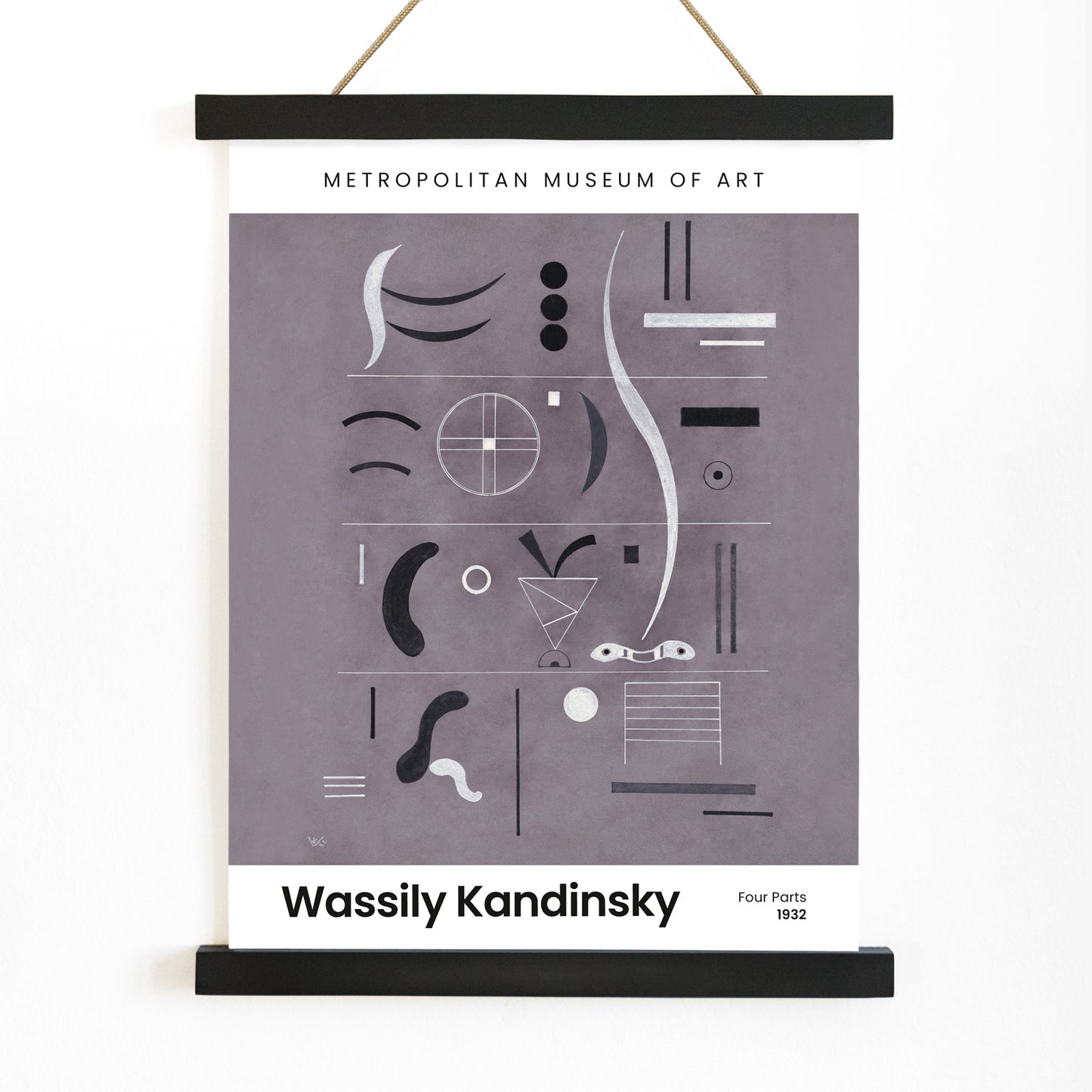
Created in 1932, Four Parts reflects Kandinsky’s fascination with structure and harmony. The title suggests a musical analogy, where each section operates like a movement in a suite, distinct yet interconnected. Rather than depicting recognizable objects, the composition explores the interplay between separate visual elements, inviting viewers to experience abstraction as a dynamic balance of unity and variety.
This artwork embodies the Bauhaus spirit, emphasizing clarity, order, and the expressive potential of pure form. It stands as a testament to Kandinsky’s belief that abstract art could evoke complex emotions and intellectual engagement without relying on narrative or figuration.
Style & Characteristics
The composition is divided into four clear sections, each featuring a unique arrangement of geometric shapes—arcs, lines, circles, and angular forms—set against a pale, neutral background. The palette is restrained, dominated by black and soft grey tones, which heighten the impact of the crisp, graphic elements.
There is a sense of measured energy throughout, as the precise placement of shapes creates visual rhythm and subtle tension. As an abstract art print, it rewards close observation, revealing how small shifts in alignment and proportion generate movement and balance within the overall design.
In Interior Design
This Kandinsky art print lends itself well to contemporary spaces, especially those with minimalist or Bauhaus-inspired aesthetics. Its structured composition and monochrome palette make it a sophisticated addition to modern living rooms, studios, or offices, where clean lines and open space enhance its visual clarity.
Pair it with matte black accents, natural woods, or pale stone surfaces to complement its geometric rigor. For a cohesive presentation, explore our frames in black or natural finishes, allowing the artwork’s balanced structure to take center stage.